
One of the most common questions we hear when discussing residential lighting is:
How much light does a room actually need?
Whether you’re planning a renovation, designing a new home or reviewing a lighting scheme, lux levels can provide a useful starting point. They help us understand how much light is required for different activities and spaces within the home.

However, lux levels are not exact rules. Every project is different, and factors such as daylight, room size, finishes and how the space will be used all play a role.
At Wink Lighting, we use recommended lux levels as part of the design process, helping to establish a baseline before considering the character and requirements of each individual space.
What Is Lux?
Lux is the measurement used to describe illuminance, or the amount of light falling onto a surface.
In practical terms, lux tells us how bright a particular area appears.
Different tasks require different levels of light. Preparing food in a kitchen requires more illumination than walking through a hallway, while reading in bed may require more focused light than the bedroom itself.
Understanding lux levels can help provide confidence that a space will feel both comfortable and practical.
Recommended Residential Lux Levels
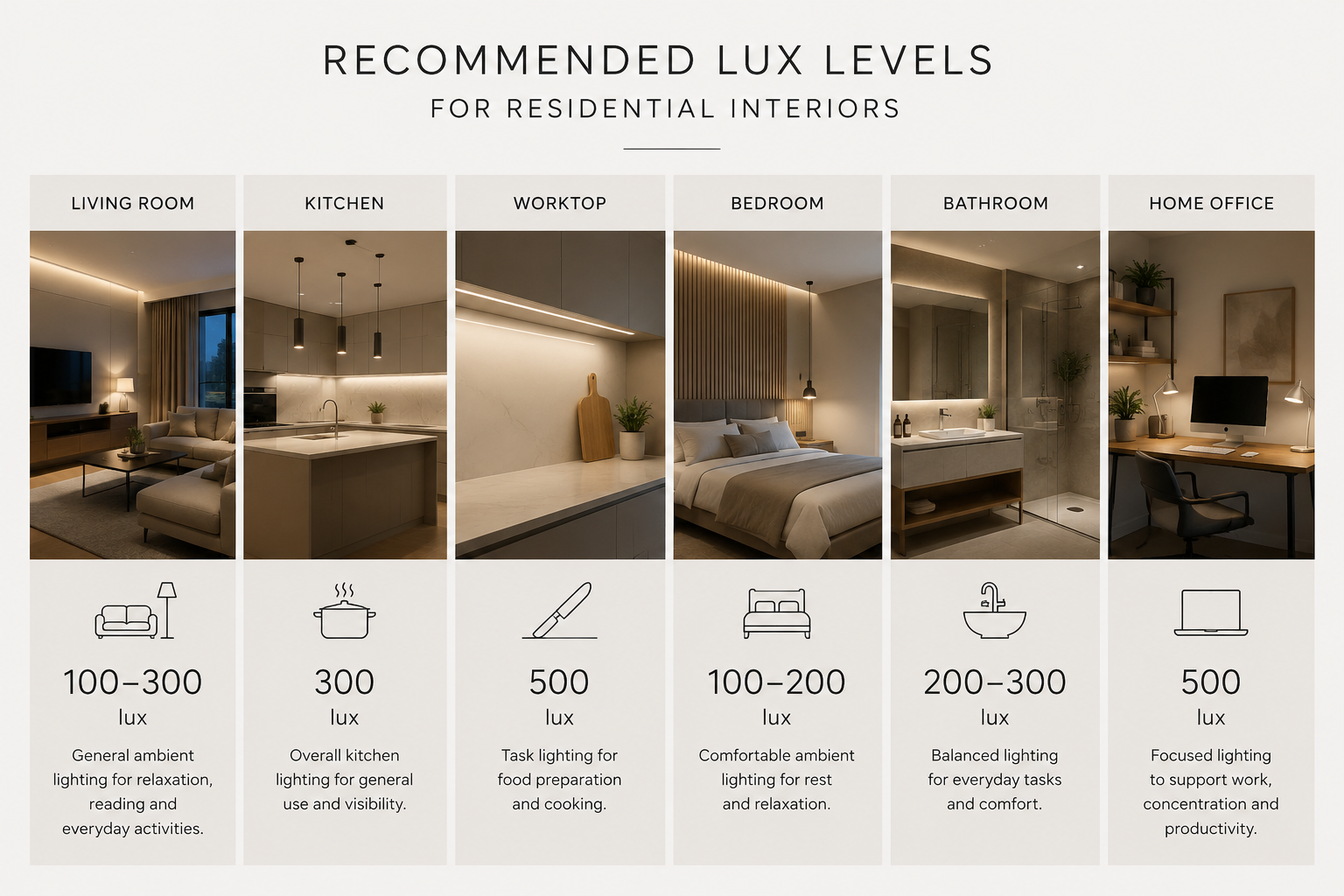
The following figures are commonly used as a guide for residential projects.
Area Recommended Lux
Hallways & Circulation 100–150 lux
Living Rooms 100–300 lux
Dining Areas 150–300 lux
Bedrooms 100–200 lux
Kitchens 300 lux
Kitchen Worktops 500 lux B
athrooms 200–300 lux
Vanity Areas 500 lux
Home Offices 500 lux
Utility Rooms 300 lux
Stairs 100–150 lux
These figures should be treated as guidance rather than strict targets.
A room that achieves the correct lux level on paper may still feel uncomfortable if the lighting is poorly distributed or overly bright.
Living Rooms
Living rooms are often used for a wide range of activities throughout the day.
Reading, entertaining, watching television and relaxing all place slightly different demands on the lighting.
General lighting levels between 100 and 300 lux are usually sufficient.
Many living spaces benefit from lower ambient lighting combined with more focused lighting where required. This allows the room to adapt between daytime and evening use.
At Wink Lighting, we often find that living rooms work best when the lighting feels calm rather than bright.
Kitchens
Kitchens typically require the highest lighting levels within the home.
General lighting levels around 300 lux provide good overall illumination, while work surfaces often require closer to 500 lux to support food preparation and cooking.
Task lighting beneath cabinets can be particularly effective in reducing shadows on worktops.
Large kitchens with significant daylight may require a different approach from smaller spaces with limited natural light.
The objective is to create a comfortable working environment without over-lighting the room.
Dining Areas
Dining spaces usually benefit from softer lighting levels than kitchens.
A range of 150 to 300 lux often works well, depending on the size and use of the space.
Pendant lighting above dining tables frequently acts as both a light source and a visual focal point.
Dimming can also play an important role, allowing the atmosphere to change between everyday use and entertaining.
Bedrooms
Bedrooms generally require lower lighting levels.
Around 100 to 200 lux is often sufficient for general lighting, with additional reading lights where needed.
Over-lighting bedrooms can make them feel less relaxing, particularly during the evening.
Bedside lighting, wardrobes and dressing areas may require more focused illumination, while the room itself often benefits from softer levels.
Bathrooms
Bathrooms need to balance practical and comfortable lighting.
General lighting levels of 200 to 300 lux are usually appropriate.
Mirror and vanity areas may require closer to 500 lux to support shaving, make-up application and grooming.
The position of the lighting is often as important as the light level itself.
Even illumination around the mirror generally produces better results than a single overhead source.
Home Offices
With more people working from home, home office lighting has become increasingly important.
Desk areas often require around 500 lux to support reading, computer work and concentration.
Natural daylight can be beneficial, but glare on screens should also be considered.
A combination of general room lighting and dedicated task lighting often produces the most comfortable working environment.

The Influence of Daylight
Natural daylight has a significant impact on residential lighting.
A south-facing kitchen with large glazing may receive substantial daylight throughout the day, while a north-facing room may depend more heavily on artificial lighting.
Seasonal changes also influence how spaces are experienced.
Lighting that feels appropriate during a bright summer afternoon may feel very different on a winter evening.
This is one reason why residential lighting design should not rely solely on achieving specific lux levels.
The relationship between daylight and artificial lighting is equally important.
Common Questions About Lux Levels
Can a room be too bright?
Yes.
Higher lux levels do not automatically create better lighting.
Excessively bright spaces can feel uncomfortable, particularly in residential settings where people want to relax.
Should every room achieve the same lux level?
No.
Different spaces have different functions.
Kitchens, home offices and bathrooms generally require higher levels than bedrooms or living areas.
Are lux levels enough on their own?
No.
Lux provides a useful benchmark, but it does not tell the whole story.
The quality, distribution and direction of light all contribute to how a room feels.
Do I need lighting calculations?
Not every residential project requires formal calculations.
However, larger homes, open-plan spaces and projects with complex lighting schemes can often benefit from additional analysis.
Final Thoughts
Recommended lux levels provide a useful starting point when planning residential lighting. They help ensure spaces are comfortable, practical and appropriate for their intended use.
However, successful residential lighting is rarely about achieving a particular number.
Daylight, room proportions, finishes and how people live within a space all influence the final result.
At Wink Lighting, lux levels help inform our approach, but the focus is always on creating lighting that feels comfortable, supports the architecture and responds to the way a home is used.
